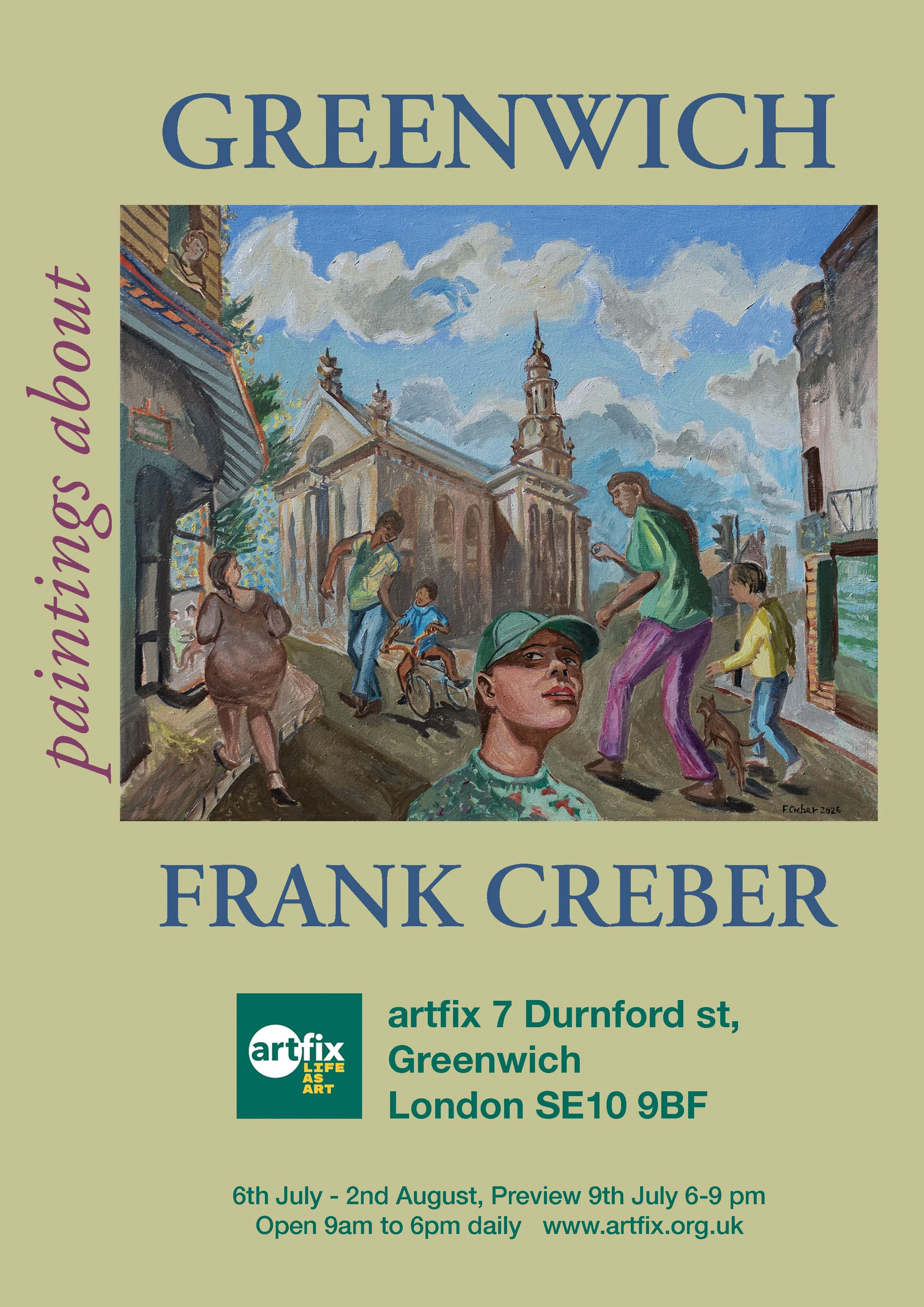
Paintings About Greenwich
Frank Creber 2026
Exhibition Introduction
Greenwich is universally recognised as the home of global seafaring, timekeeping, and naval history. Its deep maritime legacy is rooted in its historic Royal Navy welfare facilities, its role as the birthplace of the Prime Meridian, and its world-class museums dedicated to ocean exploration.
Greenwich is a place where history, myth, memory and everyday life meet. For centuries it has been shaped by the River Thames, by sailors and merchants, by royalty and science, and by stories both real and imagined. The paintings in this exhibition explore these many layers of Greenwich, drawing connections between the people who lived here, the events that took place here, and the stories that continue to give the area its distinctive character.
Many of the works are inspired by Greenwich's rich maritime heritage. The romance of sailing ships, the skills of seafarers, and the river communities that depended upon them appear throughout the exhibition. Learning to Tie Knots celebrates the practical knowledge passed from one generation of sailors to the next, while A Cabin in the Royal Hospital for Seamen recalls the lives of retired naval veterans who once lived on the site of the Old Royal Naval College. Sea Shanties evokes the songs that accompanied working sailors, preserving an oral tradition that echoed across oceans and ports.
The river itself is both a historical reality and a source of imagination. In Handel's Water Music, the famous performance commissioned by King George I unfolds on the Thames, while The Lady Who Sold Time tells the remarkable story of Ruth Belville, the "Greenwich Time Lady", who carried Greenwich Mean Time across London through the simple act of sharing the time shown on her watch. Nearby, paintings inspired by Henrietta Vansittart's pioneering propeller designs celebrate innovation and the often-overlooked contributions of women to maritime history.
Greenwich has always been a place of stories, and many of these works embrace folklore, legend and mystery. Sea Monster and Blackbeard draws upon the tales brought home by sailors returning from distant voyages, where fact and fiction often became inseparable. The Ghost on the Tulip Staircase revisits one of Greenwich's most enduring supernatural legends, while paintings of mermaids and other maritime visions explore the imaginative world that has long accompanied life at sea.
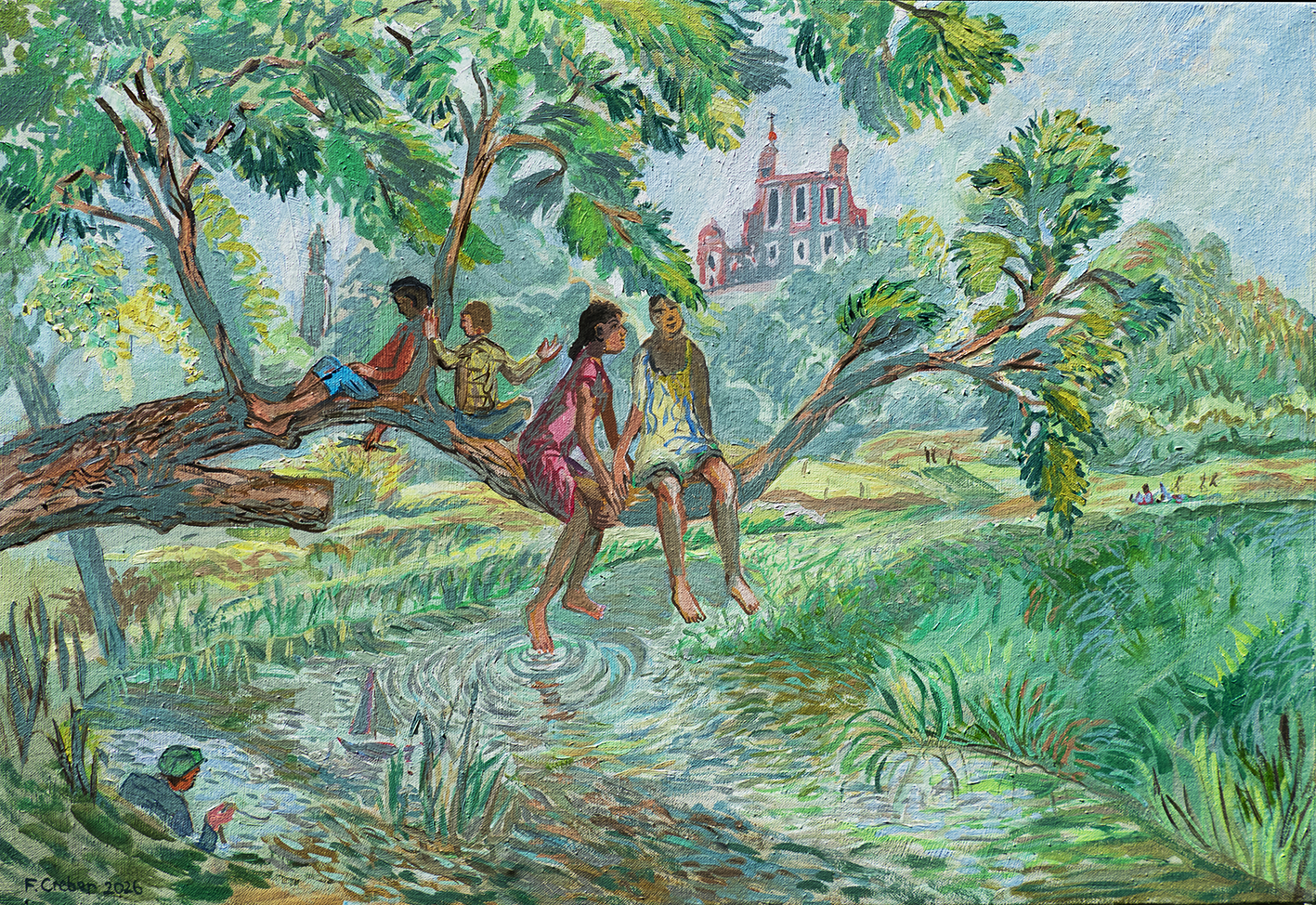
Alongside these historical and mythical themes are scenes of contemporary Greenwich. Greenwich Market captures the market as a place of conversation, exchange and discovery, where local traders, visitors and residents come together. Greenwich Park Pond looks towards the Royal Observatory from one of London's most celebrated landscapes, while Procession of Figureheads imagines Greenwich's maritime collections brought into the streets in a celebratory festival of memory and community.
Several paintings focus on individuals and places that have left a lasting mark on Greenwich. Saint Alfege, who was martyred 1012 and whose memory is preserved by the magnificent Nicholas Hawksmoor Church of St Alfege, Anne Boleyn, and the many anonymous sailors, workers and residents represented throughout the exhibition all contribute to a broader portrait of the area and its people.
Together, these paintings present Greenwich as both a real place and an imaginative landscape. They explore the historical Thames and its fishing communities, the grandeur of sailing ships, maritime folklore and legend, and the social life of pubs, streets, markets and riverside gathering places. Above all, they celebrate Greenwich as a place where past and present continually meet, and where history remains part of everyday life.
artfix 7 Durnford st, Greenwich London SE10 9BF
6th July - 2nd August,
Preview 9th July 6-9 pm
Open 9am to 6pm daily
Description of Paintings
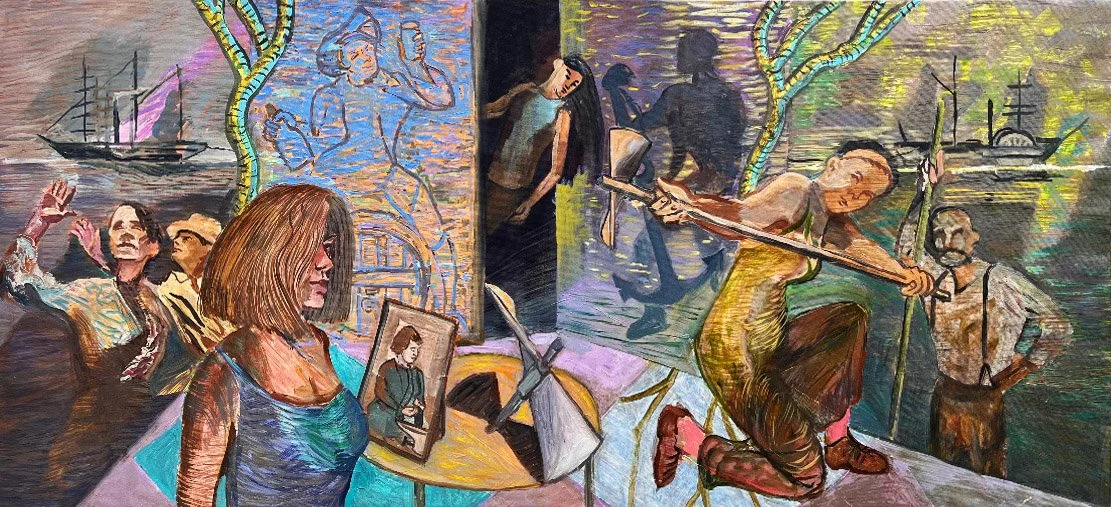
Henrietta Vansittart Propeller 56 x 122 cm
Henrietta Vansittart, née Lowe (1833 - 8 February 1883) was an English engineer and inventor, awarded a patent for a screw propeller called the
Lowe-Vansittart propeller. She was self-trained and she is considered to be one of the first female engineers, with her concentration being on ship propulsion.
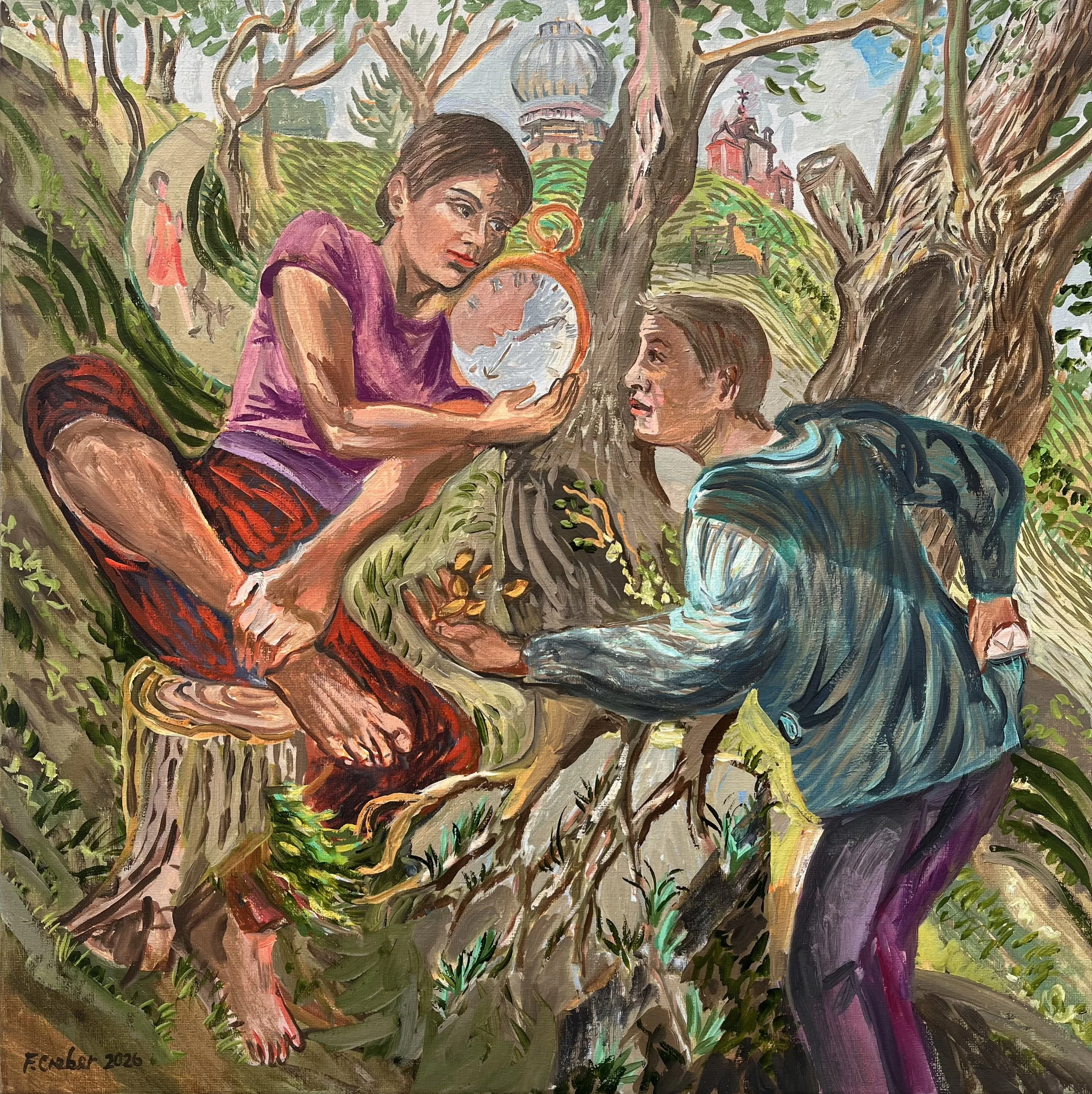
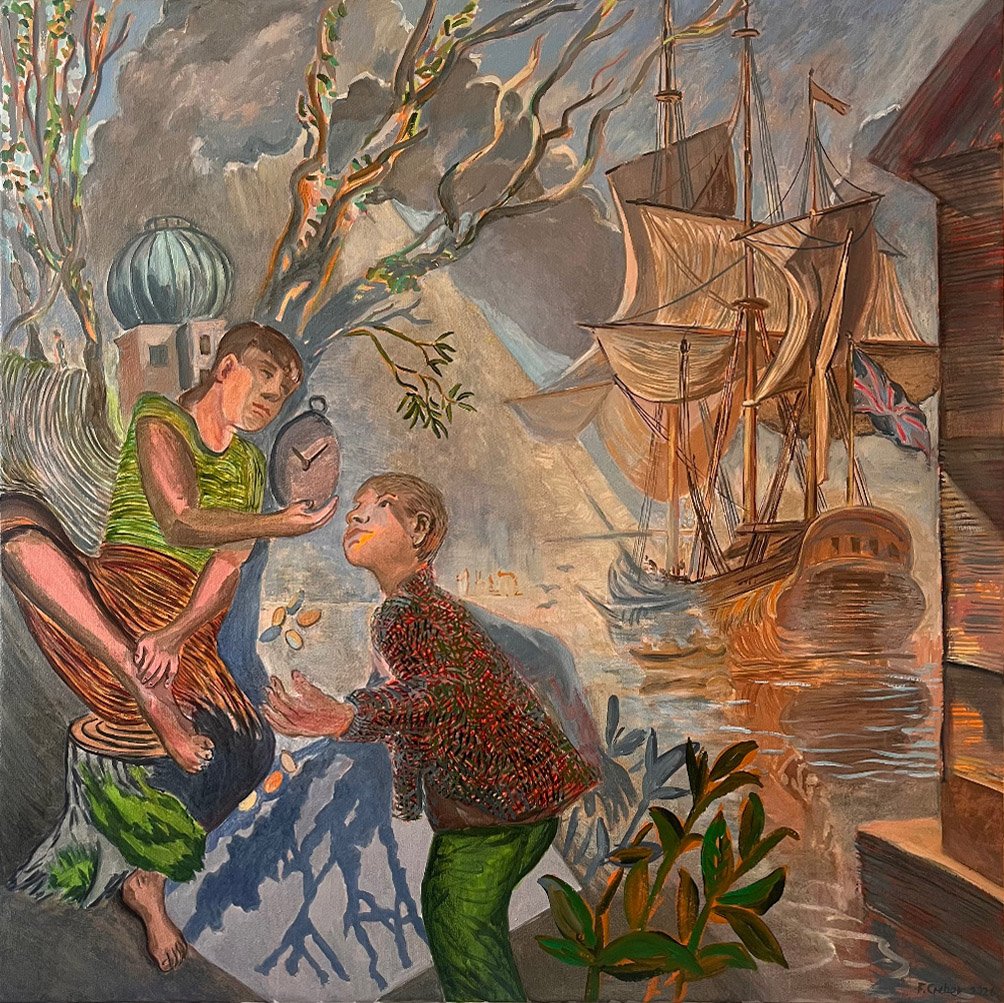
The Greenwich Time Lady 51 x 51 cm 2026
Elizabeth Ruth Naomi Belville (5 March 1854 – 7 December 1943),
Also known as the Greenwich Time Lady, was a businesswoman from London. She, her mother Maria Elizabeth, and her father John Henry, sold people the time. This was done by setting Belville's watch to Greenwich Mean Time, as shown by the Greenwich clock, each day and then "selling" people the time by letting them look at the watch and adjust theirs.
The Lady who sold time 97 x 97 cm 2026
Elizabeth Ruth Naomi Belville (5 March 1854 – 7 December 1943),
Also known as the Greenwich Time Lady, was a businesswoman from London. She, her mother Maria Elizabeth, and her father John Henry, sold people the time. This was done by setting Belville's watch to Greenwich Mean Time, as shown by the Greenwich clock, each day and then "selling" people the time by letting them look at the watch and adjust theirs.
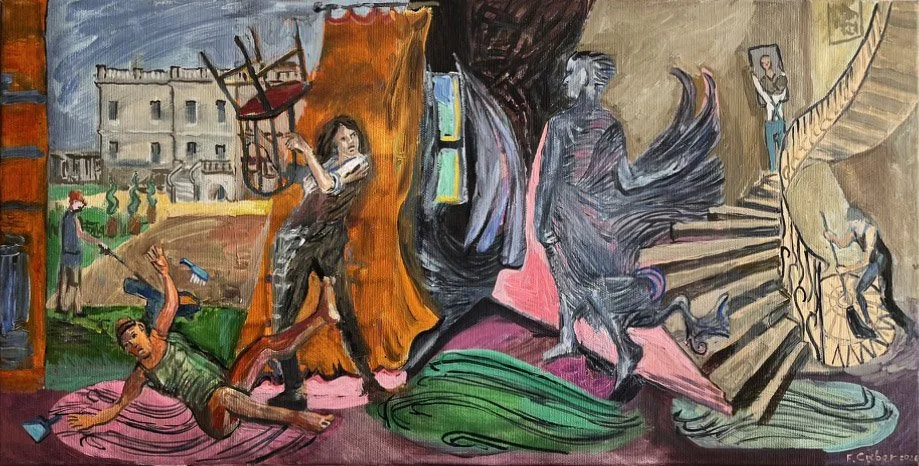
THE TULIP STAIRCASE
Located inside the Queen's House in Greenwich, the Tulip Stairs is Britain's first geometric self-supporting spiral staircase. Designed by Inigo Jones and completed in 1635, this cantilevered masterpiece is famous for its bright blue, floral-adorned wrought-iron railings and a famous 1966 "ghost" photograph.
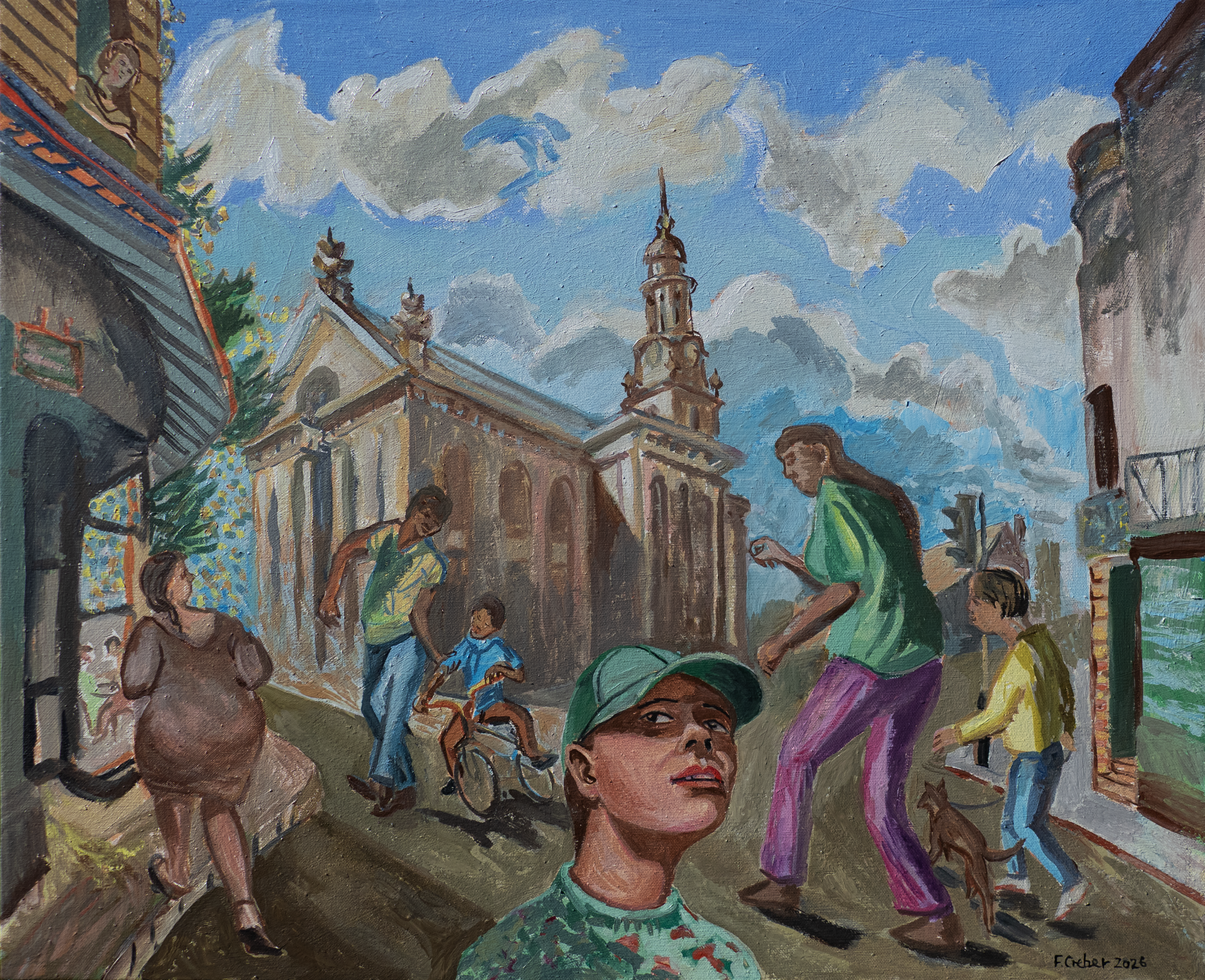
ST ALFEGE CHURCH, Greenwich 55 x 67 cm 2026.
In 2012 Saint Alfege Church Greenwich commemorated the millennium of the patron saint. Saint Alfege Who was the Archbishop of Canterbury and was taken prisoner by Danish raiders in 1011 and brought to Greenwich as a hostage. He was martyred on 19 April 1012 on the spot where St.Alfege church now stands. He was originally buried in St Paul’s Cathedral. Following the collapse of the medieval church, the present building was constructed, funded by a grant from the Commission for Building Fifty New Churches, to the designs of Nicholas Hawksmoor, one of the commission's two surveyors. The first church to be built by the commissioners, it was begun in 1712 and basic construction was completed in 1714.
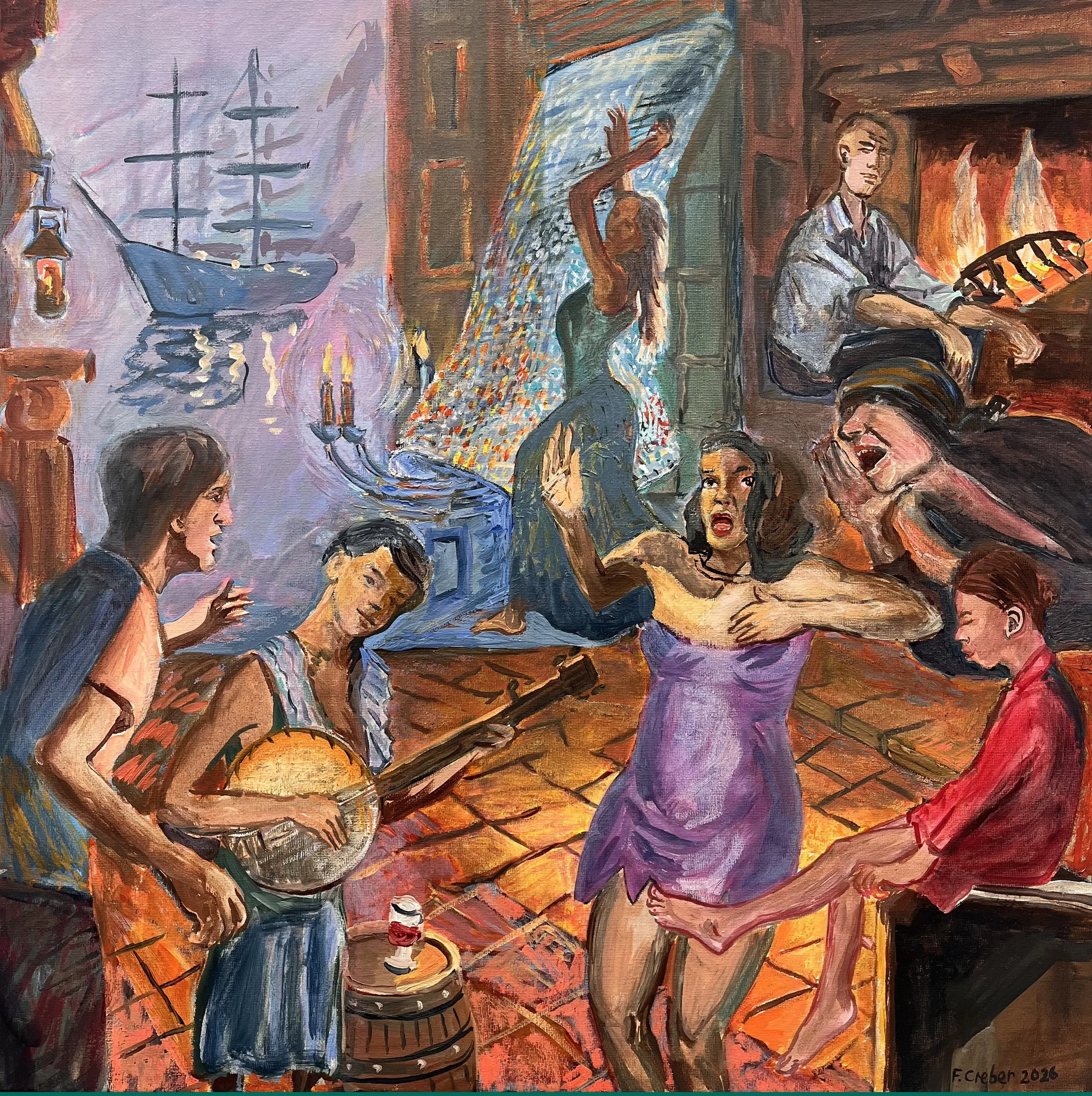
Sea Shanties, 51 x 51 cm 2026
Sea Shanties are from the oral and music tradition of working sailors. This painting is of people in a pub singing sea shanties, they are in a pub with candlelight, there is a tall ship in the view out of the window appearing through the mist,
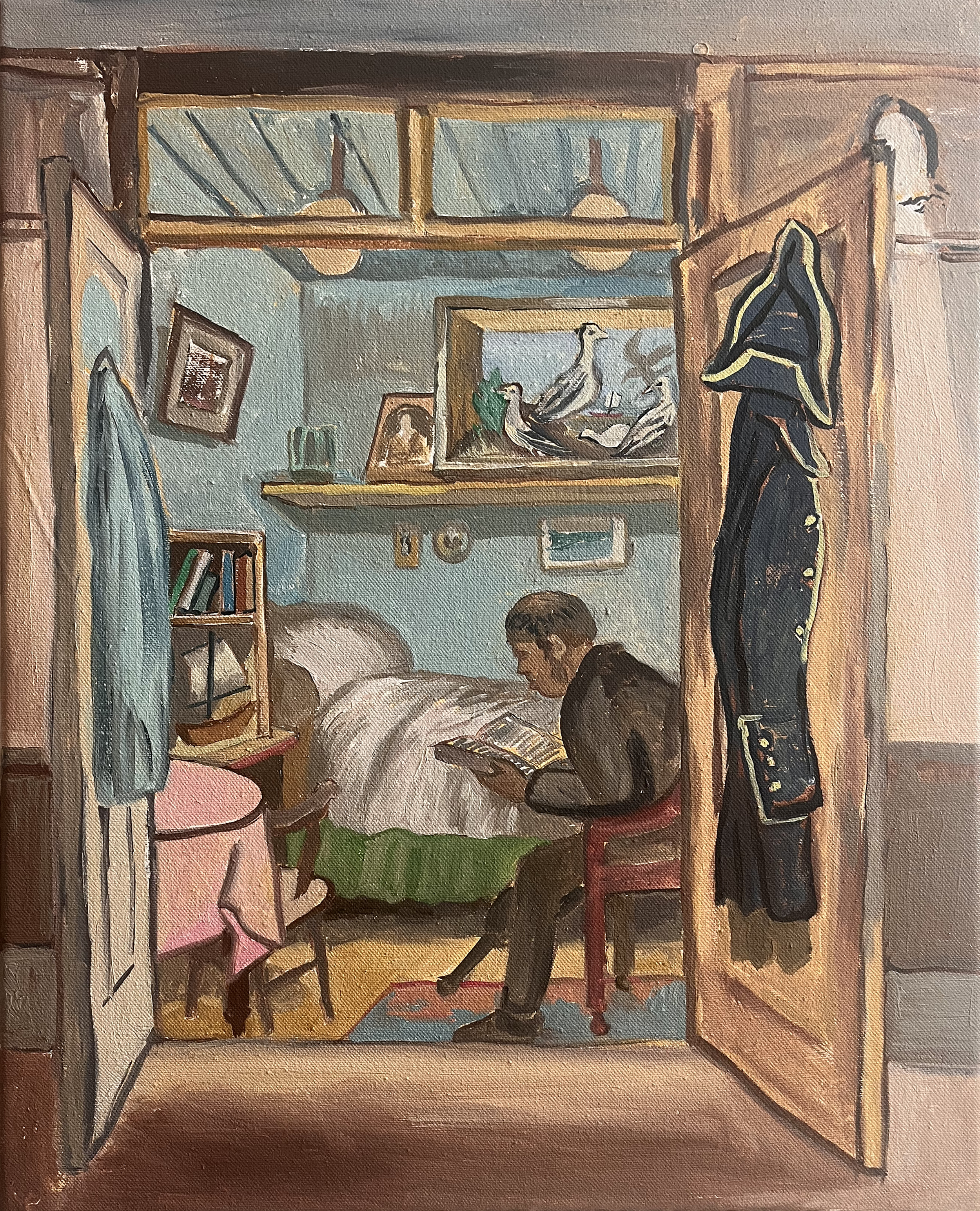
A Cabin in the Royal Hospital for Seamen 40 x 50 cm 2026
The Old Royal Naval College site in Greenwich originally housed the Royal Hospital for Seamen. Operating from 1694 to 1869, it wasn't a medical facility in the modern sense, but a retirement and care home for injured or retired Royal Navy veterans The Cabins: To maximize space and privacy, the large, dormitory-style halls were divided into smaller, individual cubicles or cabins for each sailor.
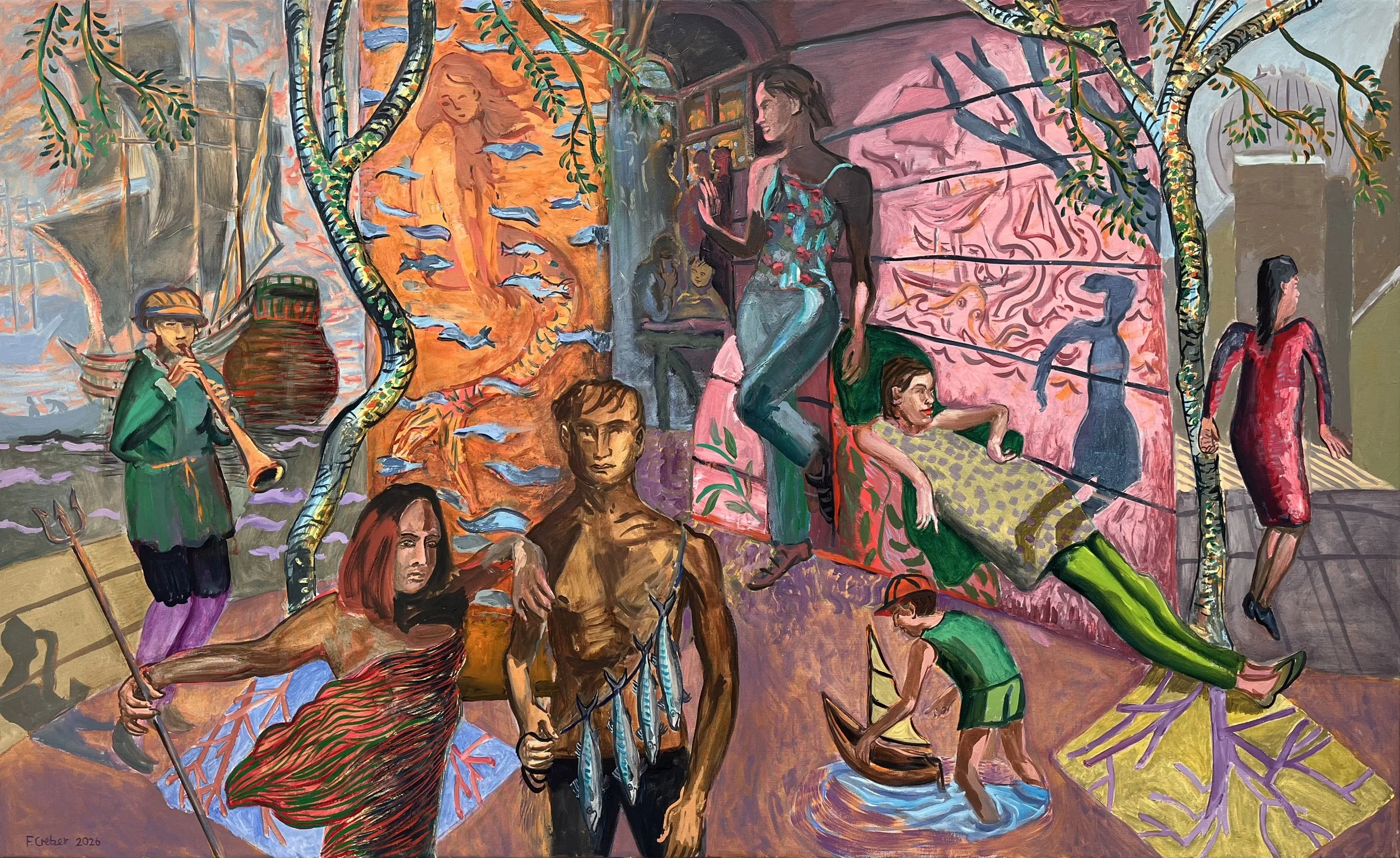
Mermaid 180 x 130 cm 2026
In folklore, a mermaid is an aquatic creature with the head and upper body of a female human and the tail of a fish. Mermaids appear in the folklore of many cultures worldwide, including Europe, Latin America, Asia, and Africa.
Mermaids are sometimes associated with perilous events, such as storms, shipwrecks, and drownings. In other folk traditions (or sometimes within the same traditions), they can be benevolent or beneficent, bestowing boons, or falling in love with humans.
There are visual references in the painting to the fishing community, a riverside bar, sleeping and dreaming.
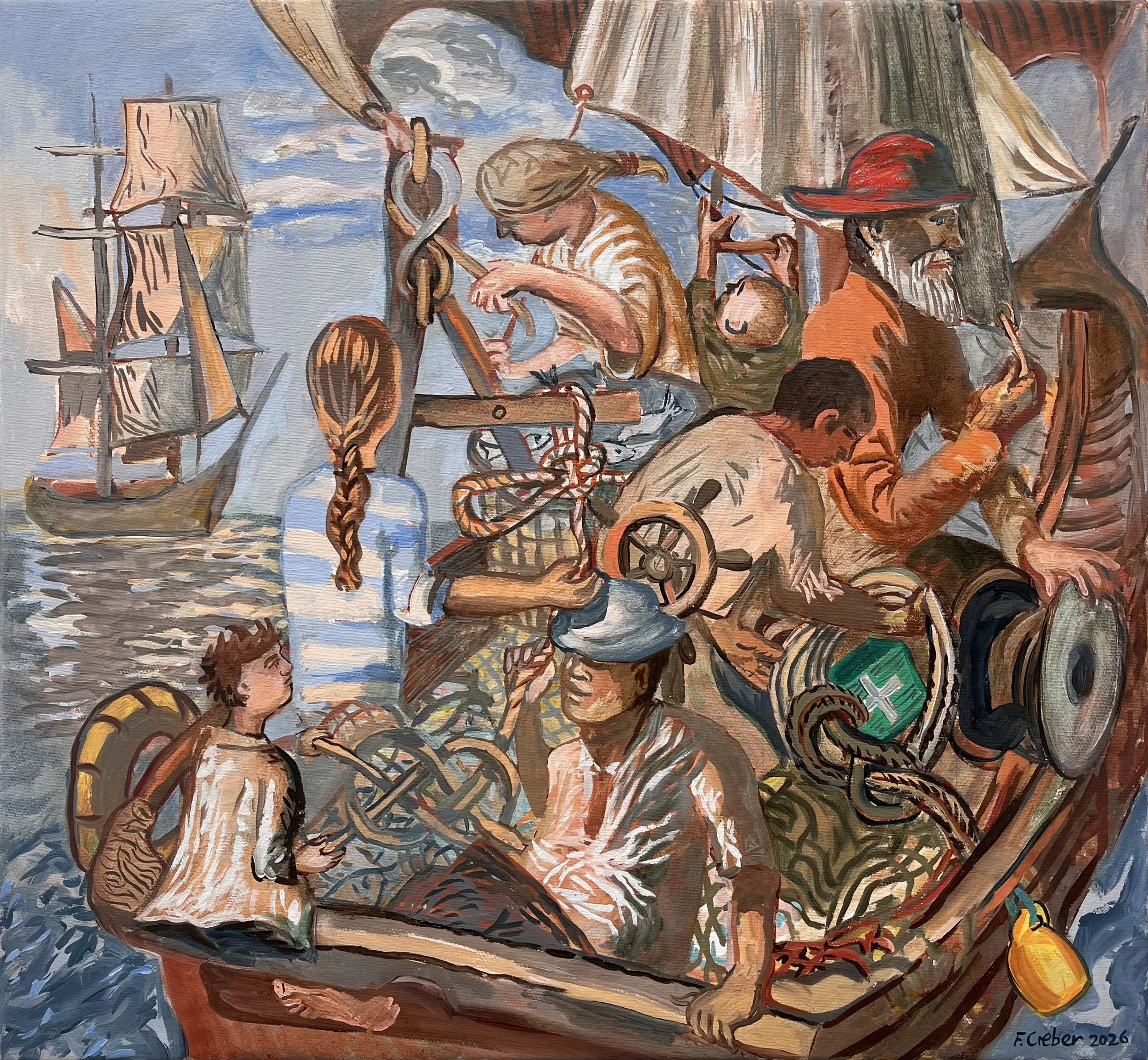
Learning to tie knots 55 x 61 cm 2026
When I learnt to sail we all had to learn to tie knots. The essential thing to understand about this is that you have to be able to untie the knot even when there is a huge strain on the leading rope, this can be a matter of life and death on the sea. The painting refers to the age of sailing ships, and about learning skills and learning and practical knowledge.
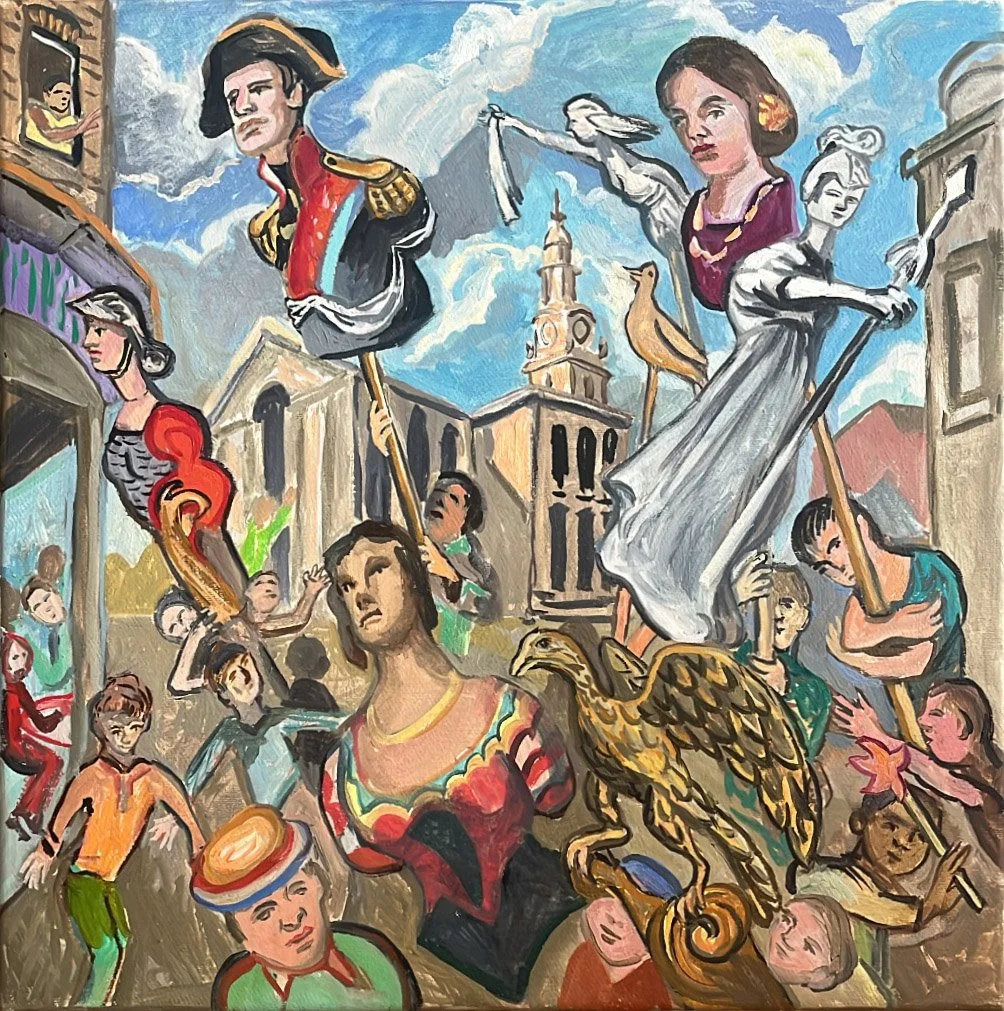
Imaginary procession of figureheads 41 x 41 cm 2026
The painting includes recognisable figureheads inspired by queens, admirals, sea gods, mermaids, warriors and allegorical figures from the National Maritime Museum collection.
The figureheads are being carried on traditional festival poles so they appear to "sail" above the crowd. A few children watching from the pavement, St Elfege church is in the background.
I made the painting as a way of connecting Greenwich's maritime history with a contemporary street scene.
Greenwich Park Pond 51 x 76 cm 2026
This is a view looking up the hill at Greenwich London with the Royal Observatory and the monument of Wolfe, in the background up the hill. This is the Boating Pond
Located right in the heart of the historic Royal Park, this lake is perfect for family-friendly water activities and strolls. Pedalos operate daily during school holidays and on weekends from April to October.
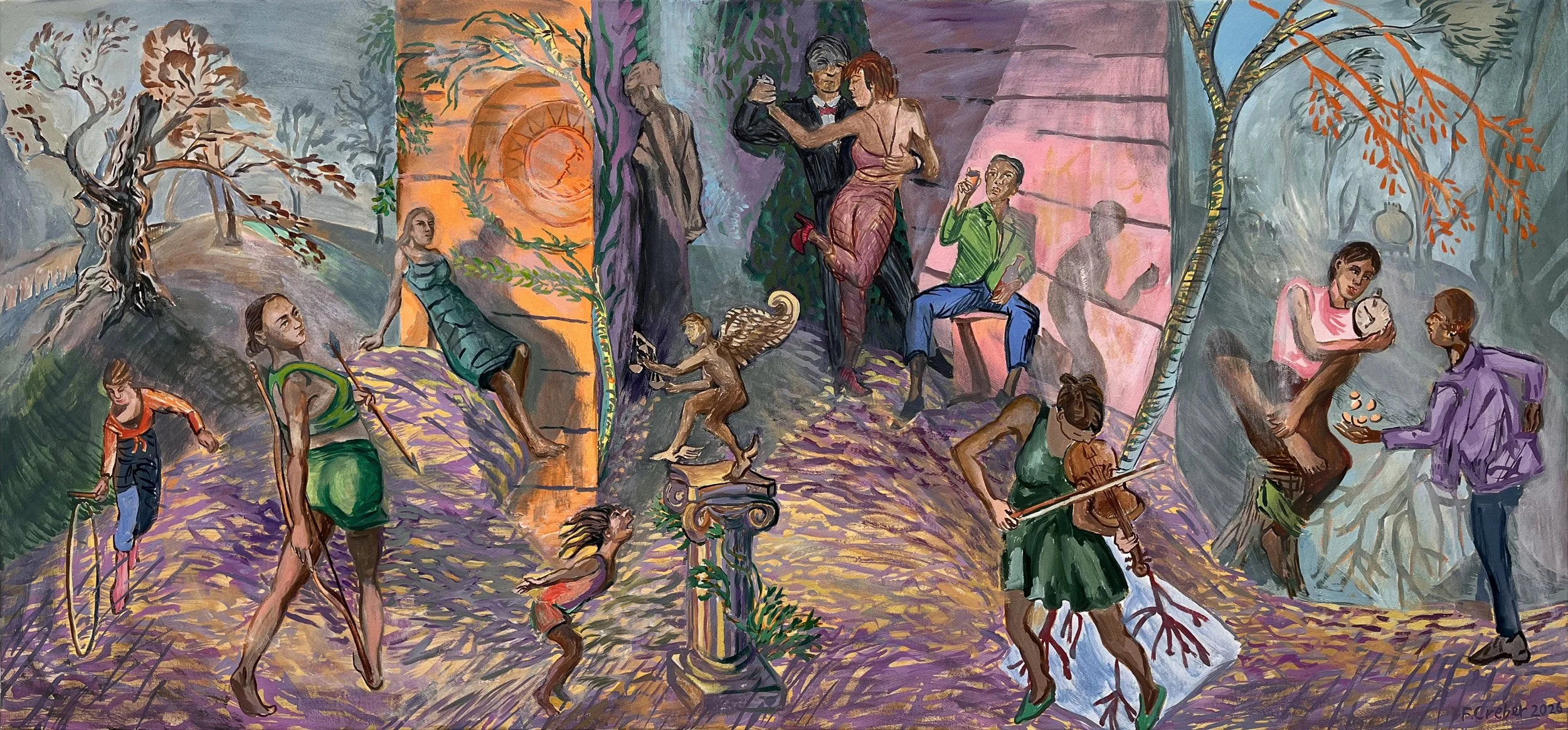
Greenwich Mean Time 57 x 123 cm 2026
As I was researching ideas about time in relation to greenwich, I would often be in Greenwich park mulling around ideas in my mind, at some point I looked up myth and legends about gods and learnt some interesting facts about the greeks god that related to time.
Aion - eternity of time always present, the cycle of day night, planets, moon. Illustrated by the partial sign of the zodiac on the orange wall and the child with a hoop and stick.
Chronos- linear and progressive time, past present and future, devouring the past. Past present and future is pictured here as a woman walking into the darkened gap in the middle of the canvas a reminder of the ever present possibility of death. The Greenwich Time Lady is also in the composition on the right.
Kairos the god: window of opportunity, grasping the moment. Kairos was personified as a god with a long quaff of hair - that you had to grab, the origin of the idea comes from archery - the archers had to weigh the moment and strength of the bow in order to time their attack to find the small gap in the armour of their opponent, in order to strike home their arrow. In the painting Kairos is pictured as a small sculpture on a pedestal and an archer.
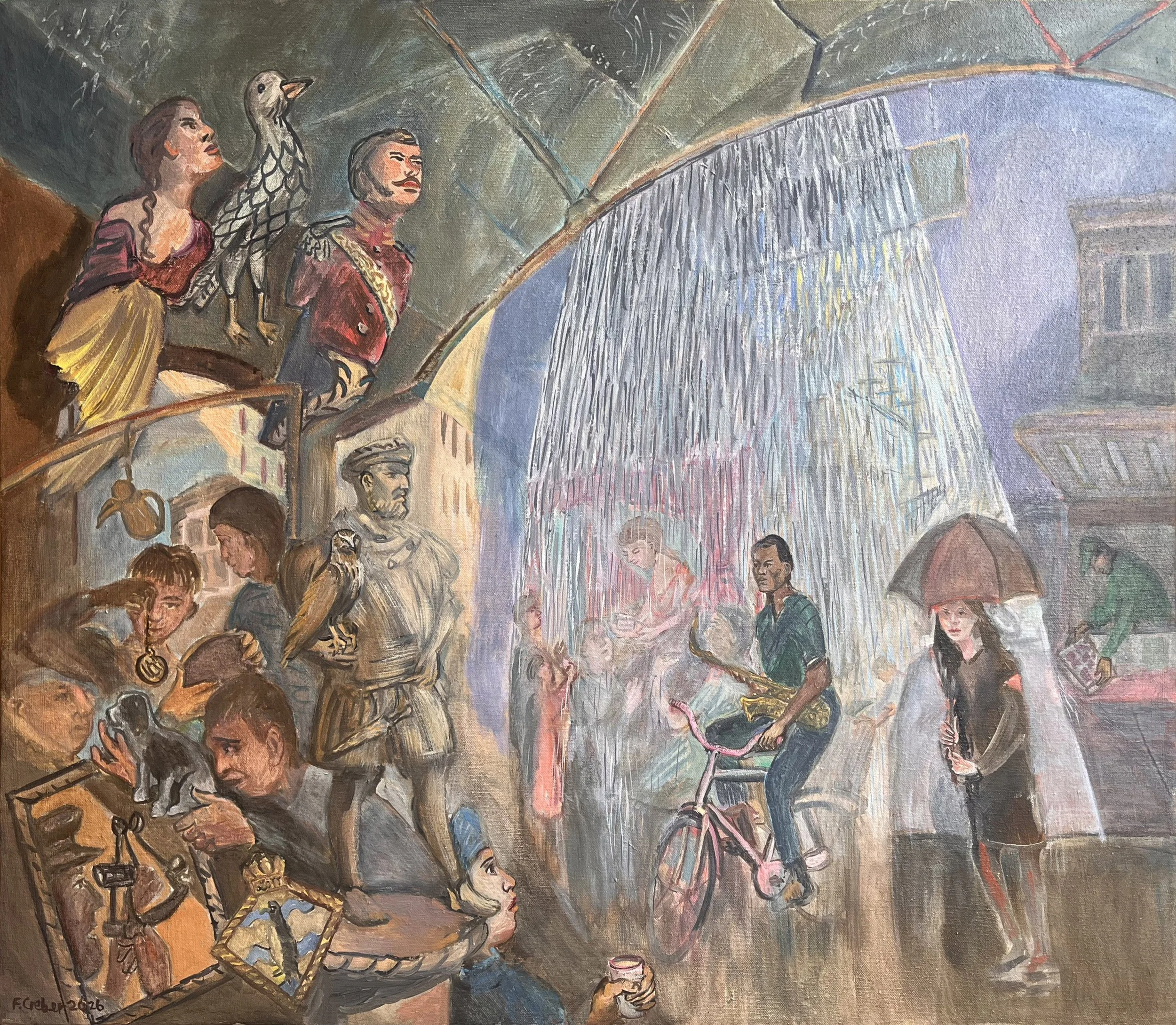
Greenwich Market in the Rain 97 x 97 cm 2026
This painting about Greenwich Market is a mixture of Figure heads, local food entrepreneurs, antique market, social meeting place, a place for tourists to rest discus, dream be inspired about their visit.
In this view of greenwich market it features Dan's antique stall, a group of friends chatting, people looking at antique objects, including a picture of a naval officer using a sextant, and a ships emblem from Scot of the Antarctic’s ship. In the foreground a small statue of king henry VIII holding a bird of prey, the Henry VIII figure is based on the statue by Anthony dufort at the old royal naval college. Henry VIII is considered the ‘Father of the English Navy’. Expanding the Fleet: Inheriting only 5 to 7 royal warships from his father, Henry VII, he grew the navy to more than 50 formidable ships, including the famous Mary Rose.
Dedicated Dockyards: To support his expanding "Army by Sea", he established royal shipyards at Deptford and Woolwich on the Thames and built the first purpose-built naval dock in Portsmouth.
Institutional Administration: In 1546, he established the Council of the Marine (later known as the Navy Board), giving the navy its first permanent administrative and logistical structure.
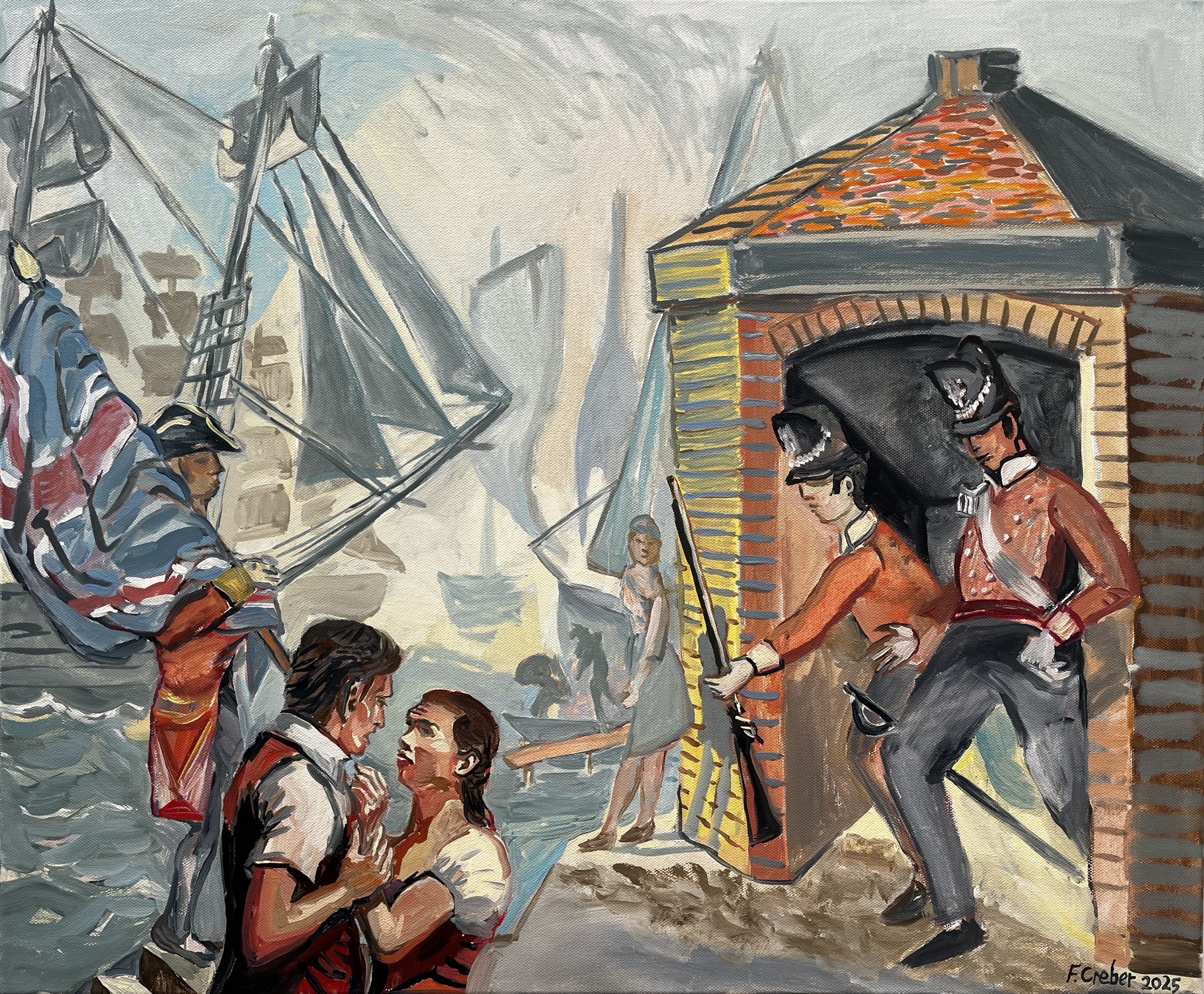
Echoes of Service 55 x 60 cm 2025
This painting is part of a series of re-enactment paintings focused on the Royal Arsenal Guard Rooms, reflecting on the lives of guards and their families set against the broader histories of war and empire.
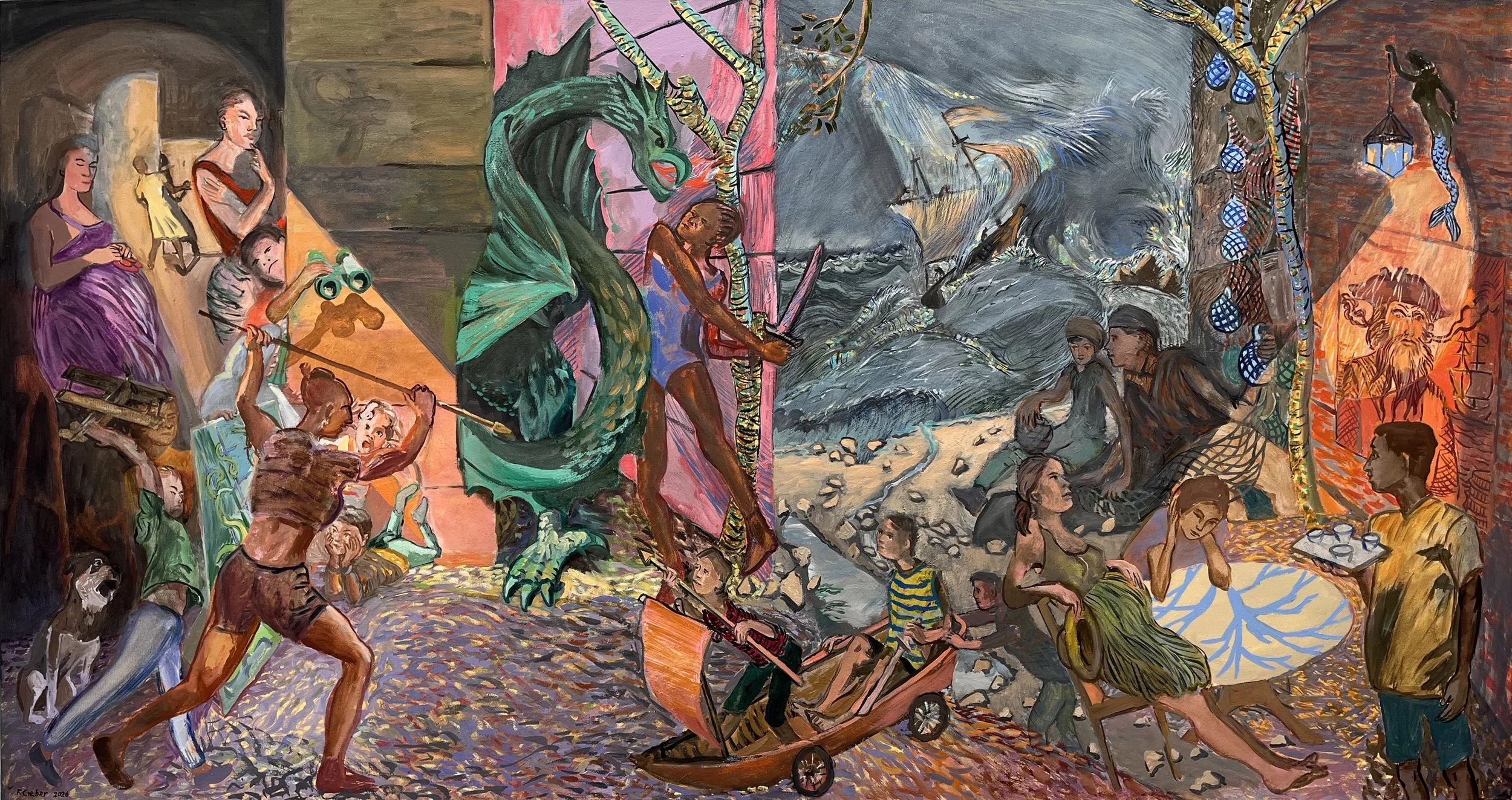
Blackbeard and the sea monster 95 x 180 cm
I have four lovely grandchildren and spending time with them over the years I have had lots of fun with imaginative play. This painting is as much about the subject matter of maritime tales of storms, sea monsters and pirates, as it is about children’s play being ignited by these stories.
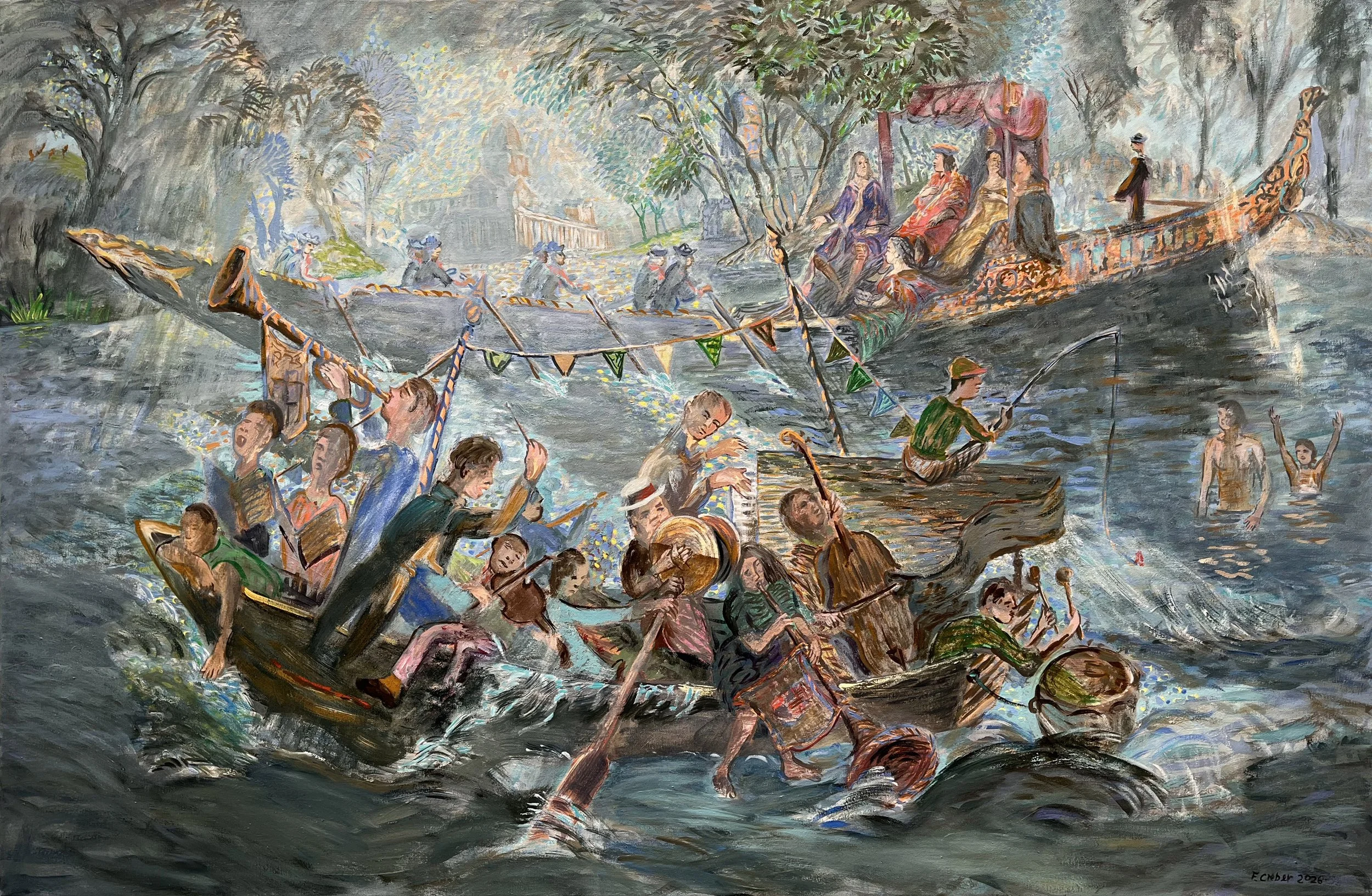
Water Music 85 x 130 cm 2026.
Handel’s Water music, played on the first time on the River Thames, with King George I who had commissioned the piece on board with Frederick Handel, played three times over because the King loved it.